
It’s been an incredibly busy time at work. Trying to remember how to do all the bits of the job that we couldn’t do virtually, with all of the people all in the same rooms, and with some incredibly challenging schedule changes has been A LOT.
Thankfully I was foolish enough to look at the Society of Wine Educators Virtual Conference ’21, smack in between back-to-back tech weeks and thought it would be a brilliant thing. . .and it was! The cost was right (free for SWE members), and the location was perfect (the guest bedroom). I was able to relax as needed, call on the concierge service playing computer games next door, and still listen to some great talks about wine.
One of my favorite presentations was done by Annie Edgerton, a fellow CSW & CSS among numerous other distinctions, about red blends. She started by talking about the modern big bold red blend, the biggest growth market in wine, and what the top three sellers seem to share. Then we talked a bit more about classic red blends. What is striking, is that they both have been made for a reason–for consistency and marketability. You may be able to say with certainly that you prefer a Right Bank Bordeaux over 19 Crimes, but the blends started out with the same purpose–to make a consistent wine using the strengths of different grapes. I won’t go into picking apart the blends used by the modern names, but I was excited to learn the trick to getting some additional information out of persistently vague marketing materials–cross reference with the Liquor Control Board of Ontario to find more specific listings of ABV and residual sugar (where I learned that the 19 Crimes Snoop Dogg Cali Red has a whopping 23g of residual sugar, which accounts for the fruity wallop!).
What I didn’t have time to do before the Conference is gather supplies for any of the taste-along portions, and Ms. Edgerton had suggested trying our own hands at blending. Thankfully I found a free day the following weekend to try out the exercise.
I chose two bottles from Simi, a Sonoma-based winery, and their 2018 Sonoma County Merlot & Cabernet Sauvignon. This was already going to be less precise than having varietals direct from the barrel–American Viticultural rules only stipulate that the named varietal be a minimum of 75% of the grapes used in the wine. That actually means that our 2018 Cabernet Sauvignon was _already_ a blend, 83% Cabernet Sauvignon, 10% Merlot, 2% Cabernet Franc, 2% Petit Verdot, 2% Malbec, and 1% Petite Sirah to be exact. The Merlot was a little more “pure” at 98% Merlot & 2% Cabernet Sauvignon. At least we know that these two should play really well together!
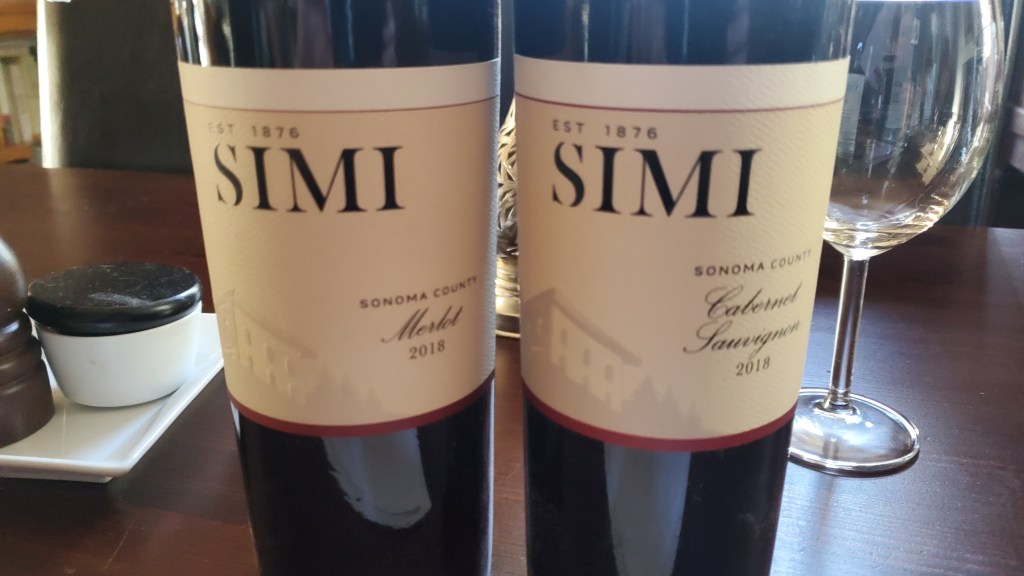
The set up was fairly simple — try each wine 100% on its own, then a glass of 75% Merlot/25% Cab, 50/50% each, and 75% Cab/25% Merlot.
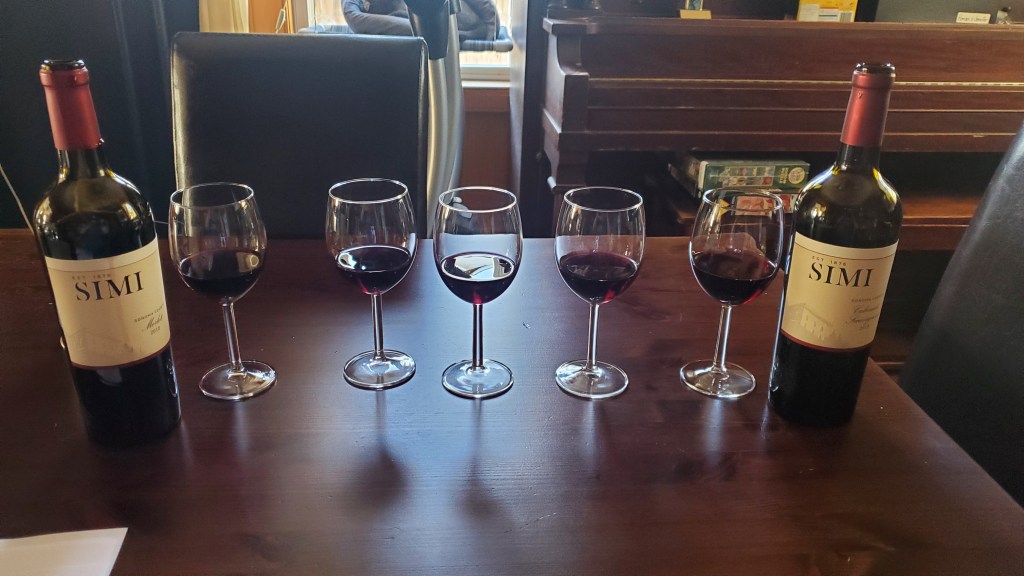
It was a real challenge at first differentiating the two wines–there was enough similarity between the two (and that seemed to be quite intentional on the part of the winemaker looking at the blends) that we had to be very carful not to get the glasses mixed up! The Merlot had much softer tannins, more oak fragrance on the nose, and a touch more ruby-purple coloring. The Cabernet Sauvignon was a more true-red, very defined tannins, and a little bit of tobacco mixed with the red fruit.
It was in the blended glasses that the differences became more pronounced. The Merlot-dominant glass had a lovely initial punch and wide flavor from the Merlot, but more backbone from the CabSauv. The Cabernet Sauvignon dominant glass felt lopsided at first–al sharp, no finesse. The 50/50 glass right away seemed the most approachable, like most red wine drinkers would find something good about it, at least by smell, but there was still a lot of fire in the first sips.
As time passed, we started noticing how the flavors developed, particularly for the CabSauv, after some time and air. Big glasses to the rescue! We pulled them out particularly to more deeply compare the 100% and 50/50 glasses. We also got out some snacks as that seemed the right thing to do as well. The Merlot became even more plush with air, and the salt and fat of our charcuterie made the berry notes sing. It even tempered the tannins of the CabSauv nicely and brought forth its black pepper notes. For R, the oak became more noticeable with the bigger glasses. These flavors also made me think of the additional grapes used in red blends that would help balance these two — I was thinking Cabernet Franc or Petit Verdot (again, I clearly think like this winemaker as they are both in small amounts in the CabSauv already). Simi does offer a 100% Petite Sirah, so that might be a fun 3rd note to try. . . Oh, and even the CabSauv dominant glass improved with air, holding on to the structure and taming the fire a bit.
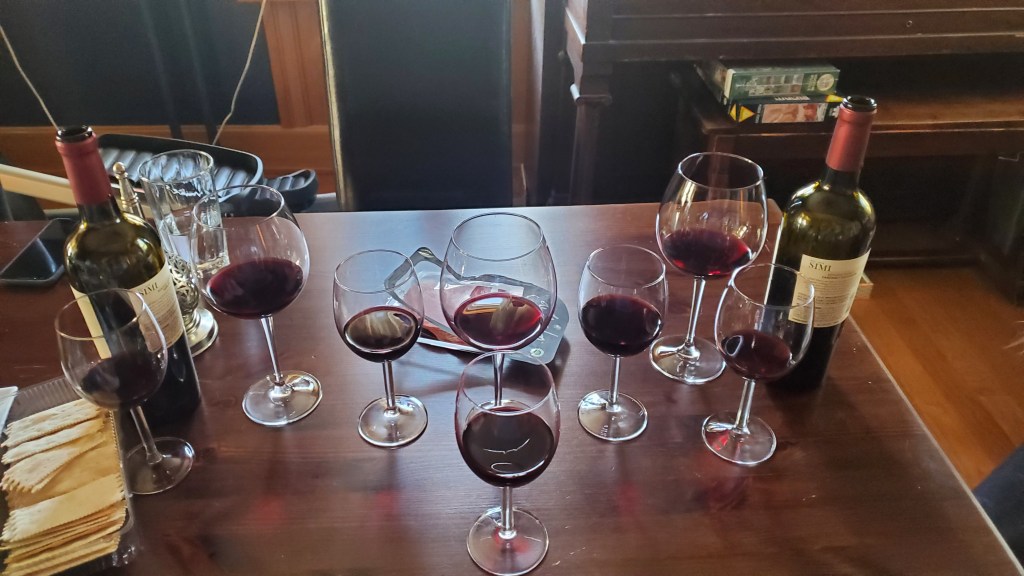
Next I pulled out my Le Nez du Vin Aroma Kit and decided to compare the base wines with the fragrances considered typical. They were both fairly standard, with small deviations that seemed to mark them more as New World.
Cabernet Sauvignon
Raspberry – Yes
Black Currant – No
Billberry (Blueberry) – No
Bell Pepper – Yes
Liquorice – Yes- (tarragon?)
Clove – Yes- (very subtle)
Smoke – Yes-
Merlot
Black Currant – Yes
Bilberry – Yes
Blackberry – Yes
Liquorice – No
Coffee – Yes-
Truffle – No
A fun reminder of the similarities and differences between these two grapes. It would be fascinating to get my hands on barrel samples to do this “for real.” Hopefully I will get a chance one day to work with a winemaker after harvest to learn more about the individual characters of the grapes before someone uses their skills on them!

 Wine Nerd (in progress)